Monday, 25 August 2014

Producing construction materials in Mongolia


By B.Zulbayar

(Published on 25th Aug 2013, The UB Post, a national English newspaper in Mongolia) 

Last week National Statistical Office of Mongolia released its much-awaited Social and Economic Report for first seven months of 2014. The disappointing figure of a 5.3% GDP for the first half of year was not welcomed by anyone.

Having said that, not all of the economic indicators have been negative. Compared to the last year figures, agriculture sector has grown by 16.3% and construction sector expanded by 10.1% which have been significantly contributed to the growth of overall economy for the period.

According to the report, there appears to be a definite correlation between the dramatic increase in the cost of imported construction materials such as cement, pipes, paints, decorating items etc. and a noticeable decline of 14.6%, which is equivalent to USD 536.9 million, in the country’s total import for the first seven months of the year.

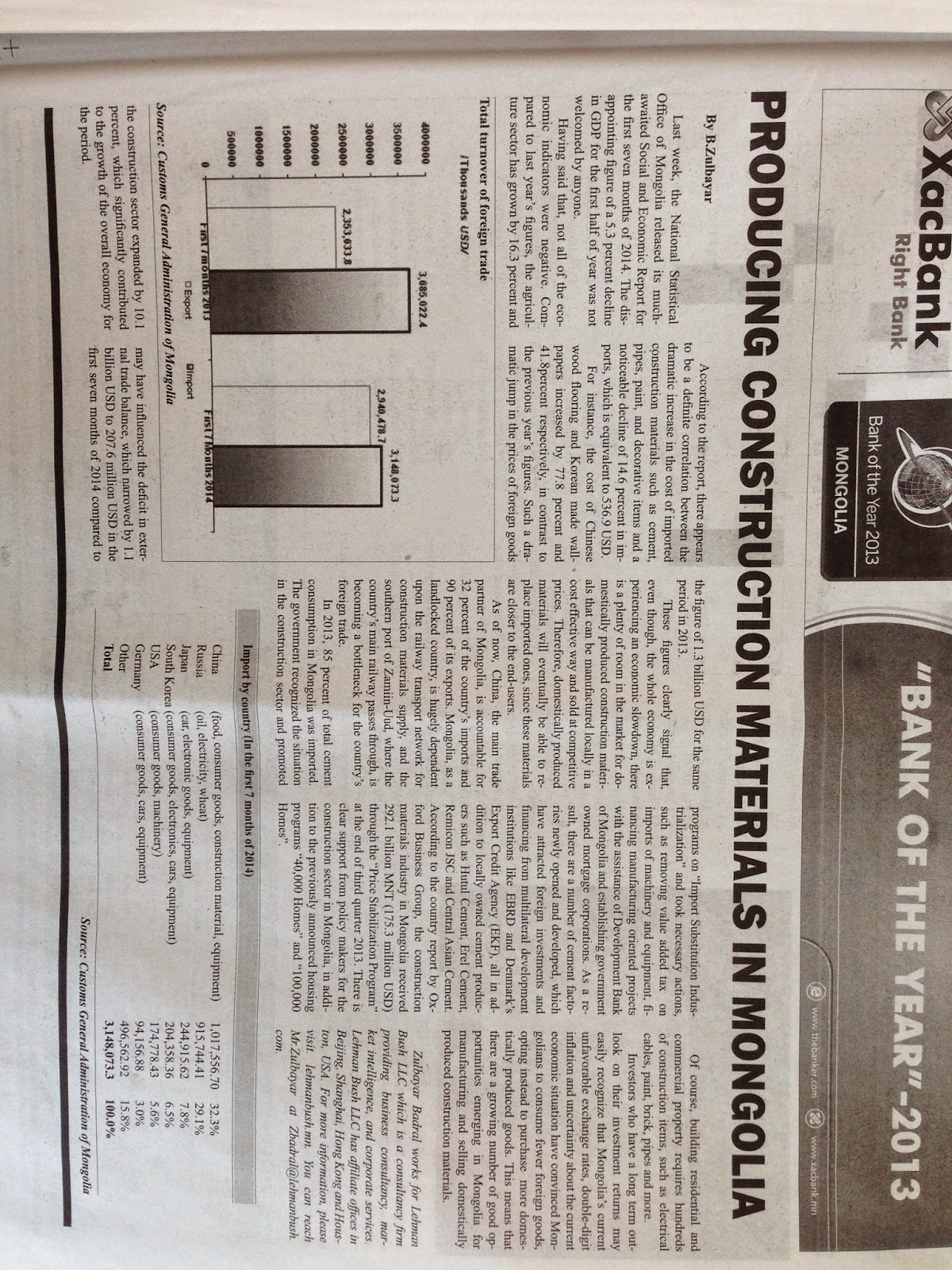
For instance, the costs of Chinese wooden flooring and Korean made wallpapers have increased by 77.8% and 41.8% respectively, in contrast to the previous year’s figures. Such a dramatic jump in prices of foreign goods may have influenced in the deficit of external trade balance to have narrowed by USD 1.1 bn to USD 207.6 ml in the first 7 months of 2014 in comparison with the figure of USD 1.3 bn for the same period of 2013.


These figures clearly signal that, even though, the whole economy is experiencing an economic slowdown, there is a plenty of room in the market for domestically produced construction materials which can be manufactured locally in a cost effective way and sold at competitive prices.  Therefore, domestically produced materials will eventually be able to replace the imported ones since these materials are closer to the end-users.

As of now, China, the main trade partner of Mongolia, is accountable for the country’s 32% of import and 90% of export. Mongolia, as a landlocked country, is hugely dependent upon transport network for construction materials supply, especially from railway. So, the southern port of Zamiin-Uud, where the country’s main railway passes through, is becoming a bottleneck of the country’s foreign trade.


Import by country (In the first 7 months of 2014)


USD (000')
%
China       (Foods, consumer goods, construction materials, equipments)
    1,017,556.70
32.3%
Russia        (oil, electricity, wheat)
       915,744.41
29.1%
Japan         (car, electronic goods, equipments)
       244,915.62
7.8%
South Korea (consumer goods, electronics, cars, equipments)
       204,358.36
6.5%
USA            (consumer goods, machinery)
       174,778.43
5.6%
Germany   (consumer goods, cars, equipments)
        94,156.88
3.0%
Other
       496,562.92
15.8%
Total
3,148,073.3
100.0%

Source: Customs General Administration of Mongolia

In 2013, 85% of total cement consumption in Mongolia were imported. The government recognized the situations in the construction sector and promoted programs on Import Substitution Industrialization and took necessary actions such as removing VAT Tax on imports of machinery and equipments, financing the manufacturing oriented projects with assistance of Development Bank of Mongolia and establishing the government owned mortgage corporations. As a result, there are a number of cement factories, either newly opened or being developed, which have attracted foreign investments or financing from multilateral development institutions like EBRD and Denmark’s Export Credit Agency (EKF) in addition to locally owned cement producers such as Hutul Cement, Erel Cement, Remicon JSC and Central Asian Cement. According to the country report of Oxford Business Group, construction materials industry in Mongolia had received MNT 292.1 bn ($175.3m) through Price Stabilization Program at the end of third quarter of 2013. Therefore, there are clear supports from the policy makers for construction sector in Mongolia in addition to previously announced housing programs such as “40 000 homes” and “100 000 homes”.  

Of course, building residential and commercial property requires a hundreds of construction items such as electric cables, paints, bricks, pipes and more.

Therefore, investors, who have a long term outlook on their investment returns may easily recognize that Mongolia’s current unfavorable exchange rates, a double-digit inflation and uncertainty over current economic situation have convinced Mongolians to consume fewer foreign goods, opting instead to purchase  more domestically produced goods. This means that are a growing number of good opportunities emerging in Mongolia for manufacturing and selling domestically produced construction materials. 

Zulbayar Badral works for Lehman Bush LLC which is a consultancy firm providing business consultancy, market intelligence, corporate services. Lehman Bush LLC has affiliate offices in Beijing, Shanghai, Hong Kong and Houston, USA. For more information, please visit. www.lehmanbush.mn. You can reach Mr.Zulbayar through Zbadral@lehmanbush.com   


Wednesday, 13 August 2014

Crafting a positive image of the nation for international business

By Zulbayar.B
(published on 13th Aug 2013, The UB Post, a national English newspaper in Mongolia) 

I am currently reading a book titled, From Third World to First: Singapore History-1965- 2000 by Lee Kuan Yew, the first prime minister and founding father of modern Singapore. Some say that he is controversial figure and suspect that he purged his political and the party’s opponents, along his way to building the world’s fourth highest per capita income nation of  Singapore which was once a former British colonial trading post in South East Asia. Having said that, in my view, Yew”s book not only teaches how to govern and develop a tiny state with multiple nationalities and big neighbors, how to deal with international investors, it also teaches how to skillfully create and manage a nation’s image on the international stage. Mongolia must project the most favorable image of itself as soon as possible to the world. This is critical to Mongolia’s future in the coming days and months ahead. It is time for Mongolia to “strut its stuff” on the world stage and announce that it is here to stay, and that it has much to offer to anyone who will take the time to have a good look.  Mongolia is open for business!

Mongolia as a country admittedly currently suffers from a much less than positive image in the world and this can readily be seen in international business media. No doubt you may have recently seen a number of very negative news reports about Mongolia’s deteriorating financial outlook by some credit rating agencies, the drop in FDI, depreciating national currency, and travel bans on expats in a few international newspapers and on some websites. Even though, behind any story there are always fact checkers, editors, co-editors along with reporters in the international media, these sporadic negative reports do not represent the true nature of what is happening in Mongolia, or present an accurate or full picture to the world.

Mongolia is a nation with great potential and it is capable of playing an important and vital role on regional and international stages; economically, socially and politically. The recent actions, taken by the government and the Mongolian parliament, such as mega deals with China, improving economic relations with Russia and China, Mongolia’s currency swap agreement with China , and the recently announced state assets’ privatization, in addition to the improved investment environment, all represent a historic, positive shift in momentum for Mongolians and foreign investors who have already placed their bets on Mongolia. 

As I have heard and said many times, Mongolia’s long term prospects look stunning. But the world will not come to Mongolia unless the world is dramatically made aware of what Mongolia has to offer it. Mongolia has to loudly “toot its own horn”!

In short, Mongolians need a more structured approach to promoting their country, just as the Singaporeans did in the 1970s. Lee Kuan Yew’s decisions to create a green Singapore, a zero-tolerance country on corruption, one of the global financial centers, and the home of multinational corporations were not easily implemented, but he succeeded by dramatically reshaping the country’s image on the international scene. He was right. Having great minds and believing in them is not enough to achieve excellent results without creating a positive image for the nation. Accordingly, the recently approved pro-investment policy of Mongolia needs more promotion and support by Mongolia’s own citizens, in addition to strong, meaningful advertising on influential international business media.

Sometimes when I look at social media it seems that many Mongolians, mostly young, educated ones who studied natural and social sciences abroad and mastered several languages, tend to moan about the country’s current economic problems such as the exchange rate, trade statistics and business regulations. And yes, it is true that some Mongolian commentators and investment analysts have a professional duty to report whatever happens in Mongolia, bad or good, to their clients and audiences with their own in-depth analysis if it is required.

However, I believe that if foreign audiences and international investors did not have any interest in Mongolia’s development and progress, then they would not constantly be asking to be informed about the country and be so eager to know more about Mongolia.Therefore, all I am asking is that these professionals be fair and unbiased about what they report, and whenever possible report positive things about Mongolia to the world.  

Nothing great was ever achieved without enthusiasm.  So, instead of excessively reporting about bad news, as torch bearers for Mongolia’s future, we should be reporting and disseminating whatever positive news and events we observe and are aware of in Mongolia to international audiences through all available means of media. By doing this, we can definitely accelerate the creation of a future we would all like to live in.

Obviously, what I discussed above is easier said than done. But we can do it! Furthermore, creating a positive image of Mongolia for the world to see is not just the government’s job, it is the job of every Mongolian citizen who benefits from the success of the nation.Hence, finding ways to project an attractive and positive image of Mongolia for international business audiences is the number one task for all. So, Mongolia may once again become the darling of international investors.

Zulbayar Badral works for Lehman Bush LLC, a consulting firm which provides business consulting, market intelligence and corporate services. Lehman Bush LLC has affiliate offices in Beijing, Shanghai, Hong Kong and Houston, Texas, USA. For more information, please visit www.lehmanbush.mn. You can reach Mr. Zulbayar through Zbadral@lehmanbush.com


Wednesday, 6 August 2014

The other side of the coin

By B.Zulbayar
(published on UB Post, 28th July 2014)
It seems that everyone is now concerned that Mongolia’s economic growth is not going to be as robust as was expected for 2014, and the country’s future prospects look a bit grey. This is not just because of the great uncertainty about the Mongolian legal environment, which has persisted since 2012. It is also due to declining commodity prices. Mongolia is very dependent upon revenues from commodities such as the precious and base metals and coal it produces.

With the recently lowered GDP growth rate estimates by international organizations, unimpressive FDI inflow statistics for the first half of 2014, a shocking inflation figure of 14.6 percent and an ever-deteriorating exchange rate, Mongolia is not yet a top destination for foreign investors, even though the country is said to be sitting on minerals worth more than one trillion USD.

However, in spite of the negative outlook from various organizations, I personally believe that predictions of doom and gloom for Mongolia are completely unwarranted, and it is due to misinformation and ignorance about Mongolia’s true potential. In fact, in my opinion, now is the best time to invest in Mongolia. Let me explain why.

Whether you agree or not, I believe my opinion is justified by a number of facts. Firstly, the recent announcements about mega project deals with China such as the one billion ton coal supply contract for the next 20 years, a Sinopec memorandum of understanding (MoU) with the Mining Ministry for a coal gasification plant, and an MoU between the Mongolian government and a consortium of GDF Suez, Sojits Corporation, Posco Energy and Newcom Group for the multi-billion dollar development of CHP-5 (Combined Heating and Power Plant) clearly illustrate Mongolia’s business potential and Mongolia’s willingness and intention to become an important player in the world’s business community.

Secondly, it is well known that commodity prices are always volatile, reflecting events and phases of the global economy and regional economic activity. We are now in a boom-bust economic cycle. When there is downward movement, then upward movement follows. 

Therefore, even though Mongolia’s main export commodities prices are now significantly lower than in previous years, they will definitely revive sooner than predicted. According to statista.com, the GDP growth rate of China, Mongolia’s biggest buyer of commodities, is predicted to be around six to seven percent until 2020. This means there will be a growing appetite and demand for copper, coal and iron ore from Mongolia’s southern neighbor.

Moreover, in addition to Mongolia’s recently passed Investment Law, Investment Funds Law and the ending of the moratorium on issuing exploration licenses, the amendments to the Mineral Law passed by Mongolian parliament on July 1, 2014, shows that foreign investment is definitely being welcomed in Mongolia from all parts of the world.

The above actions taken by the Mongolian government and the current stage of the general economic lifecycle in the country clearly support my take on Mongolia’s economy in the near future. Accordingly, my expectation is that Mongolia will be back on track again and a big economic expansion is about to happen here. In a nutshell, Mongolia’s long term economic prospects look very promising.

So, my question for you now is, when the world’s once fastest growing economy is back at the center of international investors’ attention, how would you, as a foreign investor, like to be positioned to do business in Mongolia?

My suggestion to people, whether they are professional or amateur investors, or even casual adventurers who are looking for business opportunities in Mongolia, is that now is the best time to come to Mongolia and get your slice of cake. Because some people are taking a relatively conservative and cautious position on economic prospects and the property market, you can find great properties in Ulaanbaatar for very inexpensive prices to sell later for a profit, provided that you have cash available to invest immediately.

Also, since the government has cancelled its previous ill-advised moratoriums on exploration licenses, mining activities will once again commence. Hence, suppliers’ businesses, such as catering, transportation, mining equipment, and service providers for mining companies are sure to benefit greatly. How about investing in one of these enterprises?

If the above business prospects are not what you are interested in, then, you may be interested in investing in more recession-proof industries such as the food industry, information technology and education in Mongolia, which can generate a comfortable level of income for you. In addition, professional services businesses such as accounting and legal services, and insurance and small loan services are likely to show robust growth due to strong incentives for companies to save HR costs and manage their short-term financial needs. These are just a few of the potentially profitable business opportunities in Mongolia existing now.

In addition, I can assure you that if you are an entrepreneurially minded person, then, you will be pleased to know that there are many well educated, well-qualified, energetic, young people in Mongolia who are willing to work for you during this uncertain economic time at a lower rate of pay so they may gain experience. This is a huge plus that compliments the recently revived economic and legal environment in Mongolia, which now, once more, welcomes foreign investment.

In summary, the economic and legal environment Mongolia is good now overall, and it is rapidly improving every day. There are investment opportunities in Mongolia with great potential. Therefore, my final piece of advice is to see the other side of the coin and remember, from time to time, Brian Cohen’s song “Always Look on the Bright Side of Life” from Monty Python’s “Life of Brian”. Take a closer look and see what Mongolia has to offer you!
Zulbayar Badral works for Lehman Bush LLC, a consulting firm which provides business consulting, market intelligence and corporate services. Lehman Bush LLC has affiliate offices in Beijing, Shanghai, Hong Kong and Houston, Texas. For more information, please visit lehmanbush.mn. You can contactB. Zulbayar at Zbadral@lehmanbush.com.


Monday, 3 January 2011

What sort of CV format is favourable in the UK, right now?

Recently, I have found out that writing CV is like trying to sell yourself to a potential employer. Even though it is not necessarily to be presented in colour with the best photos of yours,  CV has to give the first positive impression to the HR  department or whoever involved in selection process,  as it is the first information of you to be introduced to them.

 Of course, there are plenty of candidates who want to get the job instead of you. Hence, you have to stand out of crowd and show that you are better than others. Or at least, you are different. It is unarguable true that recruitment agencies or HR departments browse hundreds of, if not thousands, CVs everyday in order to find suitable people with required skills to fill in needed posts.

Well, let’s leave this very general bla-bla part up to here. It is just to guide you to main question that I am interested in. So, what is the main trend now in the UK?  Surely, we do not write our CV everyday, but only when it is needed by the current employer or if there is any prospect of career movement.

A while ago, I wrote my CV and it ended up in three pages which included all my personal info such as nationality, Date of Birth, (abbreviated commonly D.O.B, awkward isn’t it?), marriage status and so on. Then, I thought it was a bit long CV as some of them seemed to be not really relevant. These days, everywhere you go there are equal rights or anti-discrimination Acts. So, why on earth do I have to give my personal info like the above mentioned ones?

Ok, let’s move. Personal info is sorted! Next thing is profile. This mini self-description part, so called profile, was difficult one to write about. To be honest, I don’t think many people can describe themselves accurately. Over used clichés such as ‘motivated’ ‘team working’ ‘initiative’ should be binned! I can describe my friends and my colleagues but not myself! Can you?

Then, I searched suitable CV format on Google. And I discovered EU sample CV format. This was a kind of CV format that I will more likely to use. Clear, spacious and with relevant questions…so many advantages in it. But there are pros and cons, obviously. Since I have mentioned already good points above, let us look at bad ones. Well, to put it simply,  this European standard CV format is just too long for me. My CV is now again in three pages!

How do you feel about 3 pages CVs? Do you like detailed information or a bullet point sort of information in a CV?  Do you have any kind of favourable CV format to look at? Any suggestions are more than welcome!

Saturday, 1 January 2011

Government to shed light on the Mongolian shadow economy

It is said that the shadow economy makes up about 30% of total economy of Mongolia.

For instance, there are 7400 sole traders operate at the local markets called Narmon, Uguumur and Narantuul in Bayan-Zurkh district, Ulaanbaatar. Of those, 2900 sole traders are taxpayers and  which is equal to 40% of total sole traders at these markets. Hence, remaining 4500 people who work at the markets are to be considered as a part of the shadow economy.  

Even though 90% of the registered enterprises in Mongolia send their tax returns to the tax authority,  half of them  report loss making balance sheets.   

Therefore, creating legal environment to regulate cash sales and purchases is being highlighted as the primary solution by the government and is about to start work on it.       

source: www.news.mn
link :click here 

Nude Kiwis make my day

those crazy people (see here) make our life much more enjoyable and full of fun!